
Family Directory Software: What It Is and When You Need It
Family directory software goes beyond a contacts list to track households and relationships. Here's what it does and who actually needs it.
"Family directory software" is not a term most people go looking for until they have already tried, and failed, to make a spreadsheet or a contacts app do the job. If you have gotten tangled up trying to track a blended family, a family that spans several generations, or a group of relatives and close friends that does not map cleanly onto "immediate family," you have probably already felt the gap this category is meant to fill.
Here is what the term actually means, and how to tell if you need it.
What makes something a family directory, not just a contacts list
A contacts list stores individuals. A family directory stores relationships and structure on top of that: who belongs to which household, how people are related to each other, and how that structure changes over time as families and friends do.
That distinction shows up in a few concrete ways:
Households, not just people. A family directory treats "the Hendersons" as a single unit with a shared address and several people attached to it, rather than four disconnected entries that happen to share a last name.
Relationships that survive complexity. Blended families, remarriages, name changes, children moving out, a household that splits into two after a divorce, a chosen family that is not related by blood at all, real families do not fit a rigid family-tree structure, and a directory built only for traditional lineage breaks the moment it meets one of these. Good family directory software separates how a household is structured from how its name displays, so "the Petersons" can still render correctly whether that means a married couple, a blended household, or two roommates who consider each other family.
History, not just current state. People move, marry, and change names. A directory is only useful if it keeps the old information on record when the new information arrives, instead of quietly erasing the past every time something updates.
Kinship, not just proximity. A kinship directory in particular is meant to capture how people relate to each other, not just where they live. Parent, sibling, in-law, friend, chosen family, that layer of relationship is what turns a list of households into something that actually reflects your family.
Choosing between a contacts app and a household address book? Read What a Family Address Book App Should Actually Do.
Who actually needs this, versus who is fine with less
Not everyone needs dedicated software for this. If your contact list is a handful of immediate family members and friends whose information basically never changes, a phone contacts app is genuinely fine. Family directory software earns its place when at least one of these is true:
- Your family has enough people, households, or generations that keeping it all straight by memory or spreadsheet has become its own chore.
- Your family structure does not fit neatly into a traditional tree: blended households, family friends, relatives from more than one marriage, or a household that split and needs to stay connected to both halves.
- You send mail or invitations regularly enough that an out-of-date address is a costly recurring, not occasional, problem.
- More than one person needs to be able to update information, and you would rather approve changes than be the sole typist for the whole family.
If any of that sounds like your situation, the category exists specifically for you.
Still on a spreadsheet? Start with The Best Google Sheets Alternative for Family Contacts.
How KiriBook approaches it
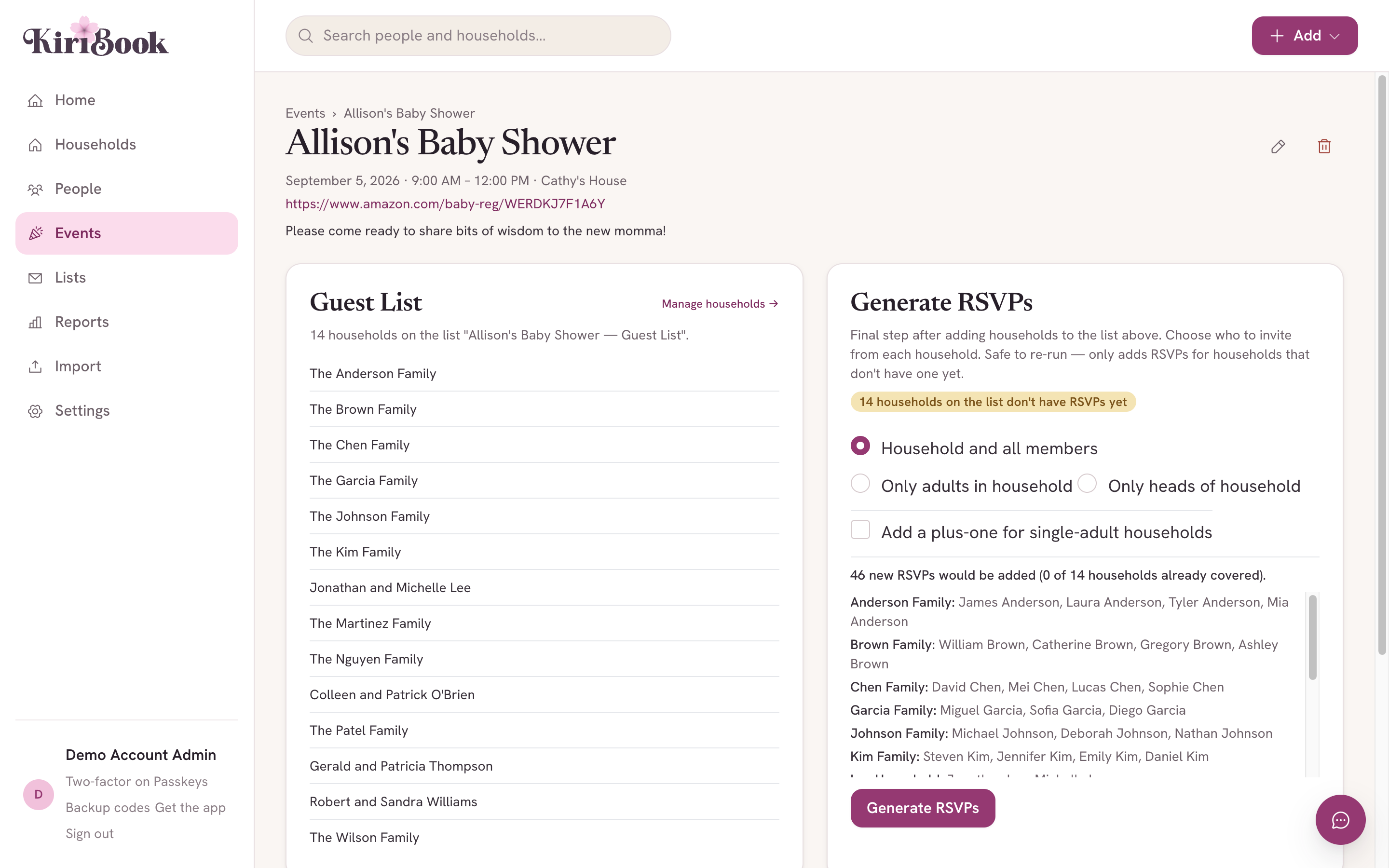
KiriBook is built as a household and kinship directory, not a general contacts app repurposed for families and friends. Every record starts with a household, holding the people who live there, their birthdays, and how they relate to one another. Relationships between people, and links between households when one splits into two or a blended family merges two households into a shared network, are part of the data model rather than an afterthought.
Naming is handled the same way: the underlying household structure is separate from how it displays, so a blended family, a same-sex couple, or a multigenerational household under one roof all render the way that family would actually describe itself, not the way a rigid template forces them to.
Addresses keep their history when people move. Tags let you group households by however you actually think about them, family, friends, chosen family, a specific event's invite list. And relatives can submit their own updates, with you approving each change before it takes effect, so accuracy does not depend on you being the only person keeping records current.
KiriBook is free for up to 25 households and 100 people. Past that, it is $59 a year for a household record that stays accurate as your family changes.
See if it fits your family
Family directory software is not for every family, but if yours has outgrown a contacts app or a spreadsheet, it is worth seeing what one built for kinship and households actually looks like. See your family as households and relationships, not disconnected rows → Free for up to 25 households, no card required.